
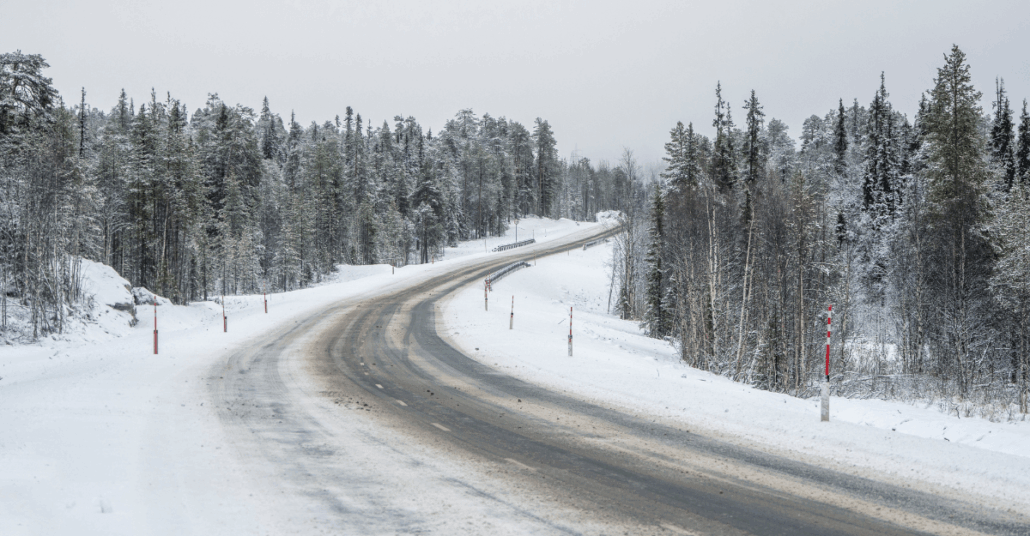
Black Ice and Blind Curves: Winter Weather Liability on West Virginia’s Mountain Roads
The winter beauty of West Virginia’s mountains is deceptive. A dusting of snow on the evergreens and a crisp morning sky can mask treacherous conditions on the very roads we travel every day. For drivers navigating the steep grades and sharp turns of I-77, Corridor H, or the winding back roads of the Alleghenies, the greatest danger is often the one you cannot see: a paper-thin sheet of black ice waiting around a blind curve or in a shaded hollow. One moment, you feel the familiar grip of tires on pavement; the next, a terrifying, silent slide begins, and the physics of the situation are no longer in your control.
When a winter weather crash happens, the immediate aftermath is a blur of shock, emergency responders, and uncertainty. It is often dismissed as just an “act of God” or an unavoidable accident. Yet, the law sees it differently. The presence of snow or ice does not give drivers a free pass to ignore the rules of the road or their fundamental duty to operate their vehicles safely.
Are Winter Crashes Really Just Accidents?
While the weather is a contributing factor, very few winter collisions are true accidents in the legal sense. They are often the direct result of a driver’s choices. The core legal principle in these cases is negligence. Simply put, negligence occurs when a person fails to use reasonable care to avoid causing harm to others.
In the context of winter driving in West Virginia, the standard of care is elevated. A “reasonable” driver is expected to adapt to hazardous conditions. This means:
- Driving significantly below the posted speed limit. The speed limit is for ideal conditions, not an icy mountain pass.
- Increasing the following distance dramatically. Stopping distances can be up to ten times longer on ice and snow.
- Ensuring the vehicle is properly maintained. This includes having adequate tire tread, functioning defrosters, and sufficient windshield wiper fluid.
- Being aware of known problem areas. Experienced local drivers know which bridges freeze first and which hollows hold ice long after sunrise.
- Postponing travel if conditions are too dangerous. Sometimes the only reasonable choice is to stay off the roads entirely.
When a driver ignores these basic precautions and causes a crash, they can be held legally responsible for the harm that results.
Who Can Be Held Liable for a Black Ice Accident?
Determining fault is rarely straightforward. Liability can rest with a single driver or be shared among multiple parties. An in-depth investigation is often needed to identify all responsible parties.
Other Drivers
The most common defendant in a winter weather claim is another driver whose actions were negligent. This could be a driver who was speeding, following too closely, texting while driving, or operating a vehicle with bald tires. Their failure to adjust to the conditions breached their duty of care to others on the road.
Commercial Trucking Companies
Tractor-trailers and other large commercial vehicles pose an enormous threat in winter weather. Due to their immense weight and long stopping distances, the consequences of a truck driver’s error are often catastrophic. Federal regulations hold trucking companies and their drivers to a higher standard of care.
Negligence in a trucking case can include:
- Pressure to drive in unsafe conditions to meet delivery deadlines.
- Inadequate driver training for mountain or winter driving.
- Poor vehicle maintenance, such as worn tires or faulty brakes.
- Violation of hours-of-service rules, leading to a fatigued driver with slower reaction times.
Government Entities
Could the West Virginia Division of Highways (WVDOT) or a local municipality be at fault? This is a legally complex question. Government entities are protected by “sovereign immunity,” which limits their liability. However, this immunity is not absolute. A government body may be held liable if it can be shown that they were negligent in their duties, such as:
- Failure to treat a known, recurring hazard. For example, if a specific bridge is known to freeze dangerously and the state fails to pre-treat or warn drivers.
- Creating a hazardous condition. If a snowplow operator piles snow in a way that obstructs vision or creates a ramp-like hazard.
- Inadequate warnings about dangerous road conditions or closures.
Pursuing a claim against a government entity involves strict procedural rules and deadlines, making it important to seek legal guidance promptly.
How Does West Virginia’s Comparative Negligence Rule Work?
A common defense tactic is to blame the victim. The other driver’s insurance company may argue that you were also driving too fast or should have seen the ice. In West Virginia, this is addressed by the modified comparative negligence rule.
This rule states that you can still recover damages as long as you are found to be less than 50% at fault for the accident. Your total compensation will be reduced by your percentage of fault.
- Example: A jury determines your total damages are $100,000. They find that the other driver was 80% at fault, but you were 20% at fault for not reacting quickly enough. You would be able to recover $80,000 ($100,000 minus your 20% of fault).
- Critical Threshold: If the jury finds you were 50% or more at fault, you are barred from recovering any compensation at all.
Insurance adjusters are skilled at using this rule to shift blame and reduce or deny payouts. Having an advocate who can build a strong case to minimize your attributed fault is vital.
What Evidence Is Needed to Prove Fault in a Winter Crash?
Because the ice and snow that caused the crash may be gone within hours, preserving evidence is a top priority. A strong claim is built on a foundation of solid proof.
Key pieces of evidence often include:
- Police Accident Report: This provides an initial assessment of the crash, diagrams, and witness information.
- Photos and Videos: Pictures of the vehicles’ final resting positions, property damage, tire marks, and the surrounding road conditions are invaluable.
- Witness Statements: Independent witnesses who saw the other driver speeding or driving erratically can provide powerful testimony.
- Vehicle Maintenance Records: These can show if a vehicle, particularly a commercial truck, had worn tires or other unaddressed safety defects.
- Event Data Recorder (EDR) Information: The “black box” in most modern vehicles can provide data on speed, braking, and steering in the seconds before impact.
- Official Weather Reports: Historical weather data can establish the temperature, precipitation, and conditions at the time of the collision.
- Accident Reconstruction Professionals: In serious cases, these professionals can use physics and engineering principles to reconstruct the crash and offer a scientific opinion on how it occurred and who was at fault.
What Types of Compensation Are Available?
A successful personal injury claim can provide financial resources to cover the immense losses caused by a serious accident. In West Virginia, recoverable damages are generally separated into two main categories.
Economic Damages
These are the direct and calculable financial losses stemming from the crash. They include:
- Past and future medical bills (emergency services, surgery, rehabilitation, physical therapy)
- Lost wages from time missed at work
- Loss of future earning capacity if you are disabled
- Costs of prescription medication and medical devices
- Property damage to your vehicle
Non-Economic Damages
These compensate for the profound, intangible human losses that have no simple price tag. They include:
- Physical pain and suffering
- Emotional distress and mental anguish
- Loss of enjoyment of life
- Permanent disfigurement or scarring
- Loss of consortium (damage to the spousal relationship)
West Virginia law places certain limitations on non-economic damages in many injury cases, which is another reason why having knowledgeable legal counsel is so important.
What Should You Do Immediately After a Crash on an Icy Road?
The steps you take in the minutes and hours after a winter wreck can protect both your health and your potential legal claim.
- Prioritize Safety: If possible, move your vehicle out of the flow of traffic. Turn on your hazard lights. If you cannot move the car or are injured, stay in your vehicle with your seatbelt on until help arrives. Roadside stops are incredibly dangerous in low visibility.
- Call 911: Report the accident and request both police and medical assistance. A police report is an essential document for any insurance claim or lawsuit.
- Seek Medical Attention: Even if you feel fine, get a thorough medical evaluation. The adrenaline from a crash can mask serious injuries like concussions or internal bleeding that may only present symptoms later.
- Document Everything: If it is safe to do so, take pictures of the scene with your phone. Get photos of all vehicles involved, road conditions, and any visible injuries.
- Exchange Information: Get the other driver’s name, address, phone number, and insurance information. Do not apologize or admit fault.
- Do Not Give a Recorded Statement: You are obligated to report the crash to your own insurance company. However, you are not required to give a recorded statement to the other driver’s insurer. Politely decline and consult an attorney first.
Experienced Legal Advocacy for West Virginia Families
The fine print in an insurance policy and the complexities of personal injury law can feel overwhelming, especially when you are trying to recover from a serious injury. A crash on a snowy mountain road is not a simple fender bender; it is a complex event that demands a thorough investigation to ensure the responsible parties are held accountable. The legal team at Powell & Majestro, P.L.L.C. is committed to protecting the rights of those injured by another’s carelessness. We know how to build a strong, evidence-based case that confronts the tactics used by corporations and insurers to evade responsibility. We believe every injured person deserves to have their story heard.
For a free, no-obligation consultation to learn more about your legal options, call our office today at (304) 346-2889 or reach out to us through our online contact form.



Leave a Reply
Want to join the discussion?Feel free to contribute!